
Roller Conveyors
Systems for Warehouses, Factories & Logistics
Roller Conveyor Systems
CSL manufactures and installs high-performance roller conveyor systems for use in warehouses, factories, and fulfilment centres.
From gravity rollers to motorised accumulation conveyors, we offer modular, low-maintenance systems designed for scalable, high-speed, and safe product handling. Our conveyors are ideal for boxes, totes, cartons, and a wide range of product types, including delicate items.


Types of Roller Conveyor Systems
CSL’s roller conveyors are available in a wide range of configurations, depending on your product size, weight, throughput, and handling needs. Our modular conveyor systems allow flexible integration and future expansion – ideal for modern warehouse and production environments.
Common options include:
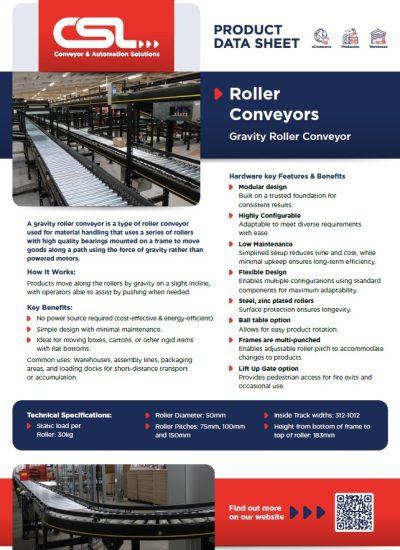
- Gravity Roller Conveyors
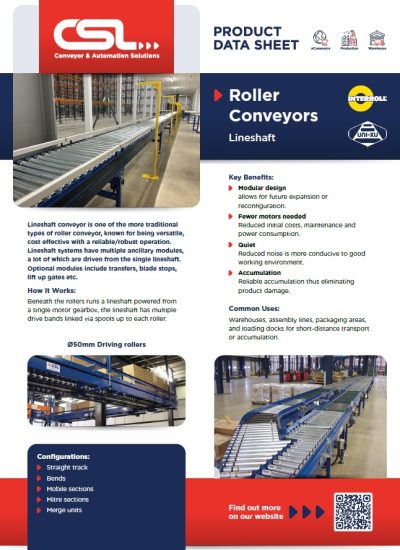
- Lineshaft Powered Roller Conveyors
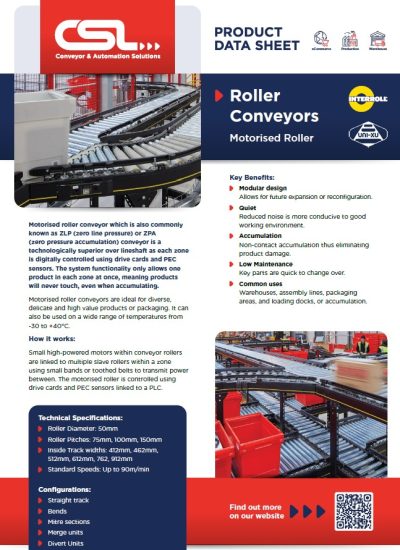
- Motorised Roller (ZLP) Conveyors
- Belt-Under-roller Conveyors

Gravity Rollers
A simple, cost-effective conveyor solution that uses gravity to move products without powered assistance.
- Operating speed: Dependent on slope and load (typically 10–30 m/min)
- Roller pitch: 60–150 mm (depending on product size)
- Frame widths: 300–1,200 mm
- Load capacity: Up to 200 kg per metre
- Best suited for: Manual handling areas, packing stations, and low-cost conveying

Lineshaft Powered Roller Conveyor
A versatile powered conveyor system driven by a rotating shaft, ideal for light to medium loads.
- Operating speed: Up to 60 m/min
- Roller pitch: 60–125 mm
- Frame widths: 400–900 mm
- Load capacity: Up to 50 kg per metre
- Best suited for: Accumulation zones, distribution centres, and tote or carton handling

Motorised Roller Conveyors (ZLP)
Individually driven rollers provide precise control, low noise, and high energy efficiency.
- Operating speed: Up to 90 m/min
- Roller pitch: 75–150 mm
- Frame widths: 400–1,200 mm
- Load capacity: Up to 80 kg per metre
- Best suited for: Zero-pressure accumulation, automated systems, and controlled product flow

Belt-Under-Roller
A robust conveyor system where a continuous belt drives multiple rollers simultaneously.
- Operating speed: Up to 80 m/min
- Roller pitch: 75–125 mm
- Frame widths: 500–1,200 mm
- Load capacity: Up to 100 kg per metre
- Best suited for: Medium-duty conveying, longer runs, and smooth product transfer

Pallet Conveyor
Heavy-duty conveyor systems designed specifically for transporting loaded pallets.
- Operating speed: Typically 10–20 m/min
- Roller pitch: 125–150 mm
- Frame widths: 800–1,400 mm
- Load capacity: Up to 2,000 kg per metre
- Best suited for: Warehousing, manufacturing, and palletised goods handling














Applications
Warehousing & Fulfilment: Putaway, picking, packing and despatch
Manufacturing & Assembly: Line‑side feeds, WIP buffers, kitting, sequencing
eCommerce Returns: Damage‑free accumulation and triage lanes
Food & Beverage: Washdown‑ready stainless options, hygienic design
Pharma & Healthcare: Clean handling with validation support
Automotive/Engineering: Pallet lines, workpiece carriers, heavy components
Download Our Datasheets
Benefits & Return on Investment
- Higher Throughput with controlled flow and accumulation
- Lower Labour & Manual Handling through ergonomic automation
- Scalability with modular sections and zoned control
- Energy Efficiency (especially 24V DC MDR with sleep modes)
- Reduced Product Damage via zero‑pressure accumulation and guided handling
- Lower Lifecycle Cost with standardised spares and robust build

Discuss your automation Project
Thank you for your interest in CSL Automation. As one of the UK’s leading conveyor and automation integrators, we can help design and install a system to help you take your business to the next level.
Start your automation journey today.
Frequently Asked Questions
How does a conveyor roller work?
Roller Conveyors from CSL
At CSL Automation, we take pride in installing belt and roller conveyor systems in facilities such as factories and warehouses. Our conveyor systems can handle various products, from lightweight polybags to heavy totes and cartons.
Our conveyor systems are designed to maximise a safe and efficient operation, moving products smoothly without any flow issues.
Roller conveyor systems are primarily used for:
- Product Transit
- Order picking
- Product sortation
- Order packing
- Order replenishment
- Our Range of Conveyor Lines
- Motorised Roller Conveyors (ZLP)
- Motorised Roller Conveyors have a 24v DC drive, ensuring safe and quiet operation. They move things faster than older systems and work well in high throughput areas where careful product handling is needed.
- Their unique design prevents products from touching (Zero Line Pressure Accumulation). This is perfect for delicate items or those with different shapes and weights, reducing damage and accumulation troubles.
- From cartons and totes to boxes, these conveyors smoothly and efficiently manage the flow without issue.
Powered Roller Conveyors (Lineshaft)
Powered roller conveyors, known as Lineshaft, are the most cost-effective champions in material handling. Using a standard SEW motor gearbox, they efficiently transfer drive through an underslung lineshaft, partnered with bands and spools.
They are hugely versatile and designed to seamlessly incorporate devices like switch sorters, right-angled transfers, and pushers. Their low-pressure accumulation ensures products remain damage-free throughout their journey.
This system truly embodies the blend of economy and efficiency.
Gravity Roller Conveyors
Gravity Roller Conveyor Systems are a cost-effective solution to enhance production flow between two points. They minimise manual handling and ensure a swifter transition of goods.
We offer a diverse selection, from steel and high-impact plastic rollers to skate wheels and heavy-duty roller sections. Our range includes extendable and mobile conveyors, providing flexibility for linking assembly lines, packaging machines, and warehouses. This creates seamless vehicle loading and unloading.
Experience the balance of affordability and effectiveness.
Can I expand or modify my conveyor system in the future?
Yes. Most conveyor systems are modular by design, meaning they can be expanded, reconfigured, or upgraded as your operational needs change. Additional rollers, frames, curves, or powered sections can usually be added without replacing the entire system, making conveyors a flexible and future-proof material handling solution
How do I know which roller type is right for me?
The right roller type depends on several factors, including the weight, size, and shape of the items being conveyed, the operating environment, and whether the system is gravity-powered or motor-driven. Load capacity, roller material (steel, stainless steel, plastic), roller diameter, and bearing type all play a role. Consulting your application requirements ensures you select rollers that deliver optimal performance and longevity.
What is the difference between roller conveyors and belt conveyors
Roller conveyors move items using a series of rotating rollers. They are best for rigid items with flat bottoms, such as boxes or pallets, and can be gravity-driven or powered.
Belt conveyors move items using a continuous moving belt driven by a motor. They are suitable for small, irregular, or loose items and provide smooth, continuous transport.
Roller conveyors move products by rolling, while belt conveyors move products by carrying them on a belt.
How do I choose between gravity and powered?
If gradients and product base allow, gravity is cost‑effective. For controlled speed, merges, accumulation or variable flows, choose powered (often 24V DC).
What information do you need for a quote?
Product size/weight/base, throughout, environment, layout sketch/constraints, and any integration points (scanners, robots, WMS/PLC)
Do you integrate with our existing lines?
Yes – Mechanically and electrically. We routinely interface with PLCs, HMIs, Scanners, printers and WMS/WCS
What about compliance?
We deliver UKCA/CE-marked systems where required, complete with risk assessment and documentation, and commission in line with PUWER obligations.
Do you maintain systems you didn't install
Yes we maintain and support systems that have not been installed by CSL Automation.
Do you offer SLAs?
Yes — we offer flexible Service Level Agreements (SLAs) tailored to the criticality of your systems and operational requirements. Our SLAs can include defined response and resolution times, remote support coverage, escalation procedures, preventative maintenance, and optional 24/7 support for business-critical environments.
Can you support us remotely?
Yes — we can provide full remote support for diagnostics, troubleshooting, software updates, PLC/HMI programming, system monitoring, and technical assistance via secure remote access tools
What are typical lead times?
It depends on the complexity of the system and the equipment specified. Typically though a project can be started from 8 weeks from the order placement.
More Infomation
Roller conveyors are used to transport goods efficiently within a warehouse, factory, or distribution centre. They are ideal for moving cartons, totes, boxes, and pallets between workstations or across multiple zones. Whether you’re handling lightweight packages or heavy loads, roller conveyors streamline material flow and reduce manual handling
Roller Conveyors from CSL
At CSL Automation, we take pride in installing belt and roller conveyor systems in facilities such as factories and warehouses. Our conveyor systems can handle various products, from lightweight polybags to heavy totes and cartons.
Our conveyor systems are designed to maximise a safe and efficient operation, moving products smoothly without any flow issues.
Roller conveyor systems are primarily used for:
- Product Transit
- Order picking
- Product sortation
- Order packing
- Order replenishment
- Our Range of Conveyor Lines
- Motorised Roller Conveyors (ZLP)
- Motorised Roller Conveyors have a 24v DC drive, ensuring safe and quiet operation. They move things faster than older systems and work well in high throughput areas where careful product handling is needed.
- Their unique design prevents products from touching (Zero Line Pressure Accumulation). This is perfect for delicate items or those with different shapes and weights, reducing damage and accumulation troubles.
- From cartons and totes to boxes, these conveyors smoothly and efficiently manage the flow without issue.
Powered Roller Conveyors (Lineshaft)
Powered roller conveyors, known as Lineshaft, are the most cost-effective champions in material handling. Using a standard SEW motor gearbox, they efficiently transfer drive through an underslung lineshaft, partnered with bands and spools.
They are hugely versatile and designed to seamlessly incorporate devices like switch sorters, right-angled transfers, and pushers. Their low-pressure accumulation ensures products remain damage-free throughout their journey.
This system truly embodies the blend of economy and efficiency.
Gravity Roller Conveyors
Gravity Roller Conveyor Systems are a cost-effective solution to enhance production flow between two points. They minimise manual handling and ensure a swifter transition of goods.
We offer a diverse selection, from steel and high-impact plastic rollers to skate wheels and heavy-duty roller sections. Our range includes extendable and mobile conveyors, providing flexibility for linking assembly lines, packaging machines, and warehouses. This creates seamless vehicle loading and unloading.
Experience the balance of affordability and effectiveness.