
The Real Cost of Conveyor Downtime
When a conveyor system stops unexpectedly, the immediate problem is obvious – production halts. But the full financial impact of unplanned downtime extends well beyond the moment the line goes down. For ecommerce businesses, 3PL providers and manufacturers that depend on automated handling systems, even a short stoppage can trigger a cascade of costs that far outweigh the price of preventative maintenance.
This page breaks down what conveyor downtime actually costs UK businesses, and how a structured maintenance contract can protect your operation before a breakdown happens.
Explore ConveyorCare Contracts
Talk to the ConveyorCare Team
What Happens When a Conveyor System Goes Down?
An unplanned conveyor stoppage doesn’t just pause your output – it sets off a chain of consequences across your operation:
Lost throughput. Every hour your conveyor is offline is an hour of orders not picked, packed or dispatched. For a mid-sized ecommerce operation processing 5,000 units per shift, even two hours of downtime can mean thousands of missed fulfilments.
Idle labour costs. Your warehouse staff don’t stop being paid because the conveyor has stopped. During an unplanned breakdown, operatives may be standing idle or redeployed inefficiently while engineers diagnose the fault.
Emergency call-out fees. Without a service agreement in place, emergency engineer call-outs are charged at premium rates – often significantly higher than the equivalent cost under a planned maintenance contract. Parts sourced urgently attract similar premiums.
Knock-on delays. In high-volume operations, a two-hour stoppage rarely results in just two hours of lost output. Backlogs build, subsequent shifts are affected, and in some cases customer SLAs are missed entirely.
Reputational impact. Late deliveries and missed dispatch windows affect customer satisfaction scores, repeat purchase rates and – for 3PL providers – contractual performance metrics.
Reactive vs Planned Maintenance - The Cost Comparison
Industry data consistently shows that reactive maintenance costs significantly more than preventative planned maintenance (PPM). Estimates vary by sector and system complexity, but the principle is consistent: organisations that wait for a breakdown to occur before calling an engineer spend considerably more per intervention than those on a structured service plan.
The reasons are straightforward:
- Emergency call-out rates are higher than scheduled visit rates
- Parts sourced urgently cost more than parts ordered in advance
- The fault that caused the breakdown may have been developing for weeks – meaning a greater repair scope by the time it fails
- Secondary damage can occur when a failing component is left undetected
A ConveyorCare contract from CSL converts unpredictable, high-cost reactive spend into manageable, budgeted planned maintenance – with emergency cover built in.

The Hidden Cost Most Businesses Overlook
One of the most commonly underestimated costs of poor conveyor maintenance is the gradual degradation of system performance before a full breakdown occurs. Worn belts, misaligned rollers, and early-stage bearing failure all reduce throughput and accuracy long before they cause a stoppage.
This means businesses operating without regular servicing are often running below optimal efficiency without realising it – paying the cost of a poorly maintained system in slow throughput and increased error rates, not just in downtime events.
Regular PPM from CSL identifies and addresses these issues before they affect performance or cause failure.

What Does an Unplanned Stoppage Actually Cost?
Every operation is different, but a straightforward calculation helps illustrate the exposure:
- Average throughput value per hour (units processed x margin per unit)
- Plus: idle labour cost per hour (headcount x average hourly rate)
- Plus: emergency call-out and parts cost (typically £500–£1,500+ without a contract)
- Plus: any customer penalties or SLA credits triggered by missed dispatch
For many mid-sized warehousing and ecommerce operations, a single unplanned breakdown lasting four to eight hours comfortably exceeds the annual cost of a Bronze or Silver ConveyorCare contract.
How CSL ConveyorCare Reduces Your Downtime Risk
ConveyorCare is CSL’s structured maintenance and aftersales programme, available across three tiers – Bronze, Silver and Gold – and open to any conveyor or automation system, regardless of who originally installed it.
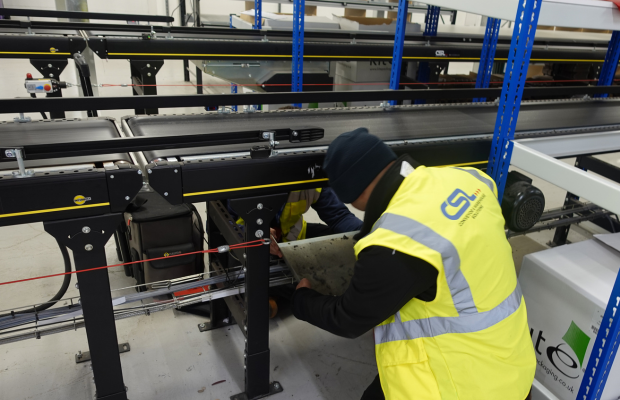
Preventative Planned Maintenance (PPM) sits at the core of all ConveyorCare contracts. Scheduled inspections identify wear, misalignment, and developing faults before they escalate – keeping your system running at peak performance between visits.
Defined emergency response. For businesses that need guaranteed response times, ConveyorCare contracts include SLA-backed emergency call-out, with engineer response times agreed at contract outset.
Spare parts availability. CSL can supply spare parts for both CSL-installed systems and third-party conveyor systems, reducing the time between fault identification and resolution.
Budgeted maintenance spend. A ConveyorCare contract converts unpredictable reactive costs into a fixed, planned expenditure – making it significantly easier to manage and justify maintenance budgets internally.
Protect Your Operation with ConveyorCare
The question isn’t whether your conveyor system will need maintenance – it’s whether that maintenance happens on your terms or in response to an emergency.
A ConveyorCare contract from CSL puts you in control: scheduled visits, defined response times, access to spare parts, and an experienced engineering team that understands your system.
Frequently Asked Questions
How much does conveyor downtime cost per hour?
The cost varies significantly depending on the size of your operation, your throughput volume and your labour structure. However, when idle labour, lost output, emergency call-out fees and any customer penalty costs are combined, most mid-sized warehousing operations face costs of several hundred to several thousand pounds per hour of unplanned stoppage.
Is a conveyor maintenance contract worth it for a smaller operation?
In many cases the value of a planned maintenance contract is proportionally higher for smaller operations, where a single breakdown event has a greater impact on overall output and where there is less internal engineering resource to diagnose and resolve faults quickly.
Can CSL maintain a conveyor system that wasn't installed by CSL?
What is Preventative Planned Maintenance (PPM)?
PPM is a scheduled approach to conveyor servicing in which engineers inspect and service your system at regular intervals – identifying developing faults, wear and misalignment before they cause a breakdown. It is the most cost-effective way to maintain conveyor performance and extend system lifespan.
How quickly can CSL respond to a conveyor breakdown?
Emergency response times are defined by your ConveyorCare SLA, agreed at the outset of your contract. CSL offers 24/7 emergency breakdown cover with on-site response times specified for your tier.
