

Inside Wiggle's Fulfilment Centre: Designing a Pack and Sortation Conveyor System
When a growing online retailer outgrows its buildings, the problem is rarely storage alone. It is the flow of orders through the building: how packed consignments move from pick faces to dispatch without bottlenecks, damage, or misrouting.
That was the challenge Conveyor Systems Ltd (CSL) took on for Wiggle, and it is a useful worked example of what a well designed pack and sortation conveyor system actually has to do.
Wiggle is a major UK online retailer for cycling, running and swimming, and was voted the Which? recommended number one online outdoor and leisure shop.
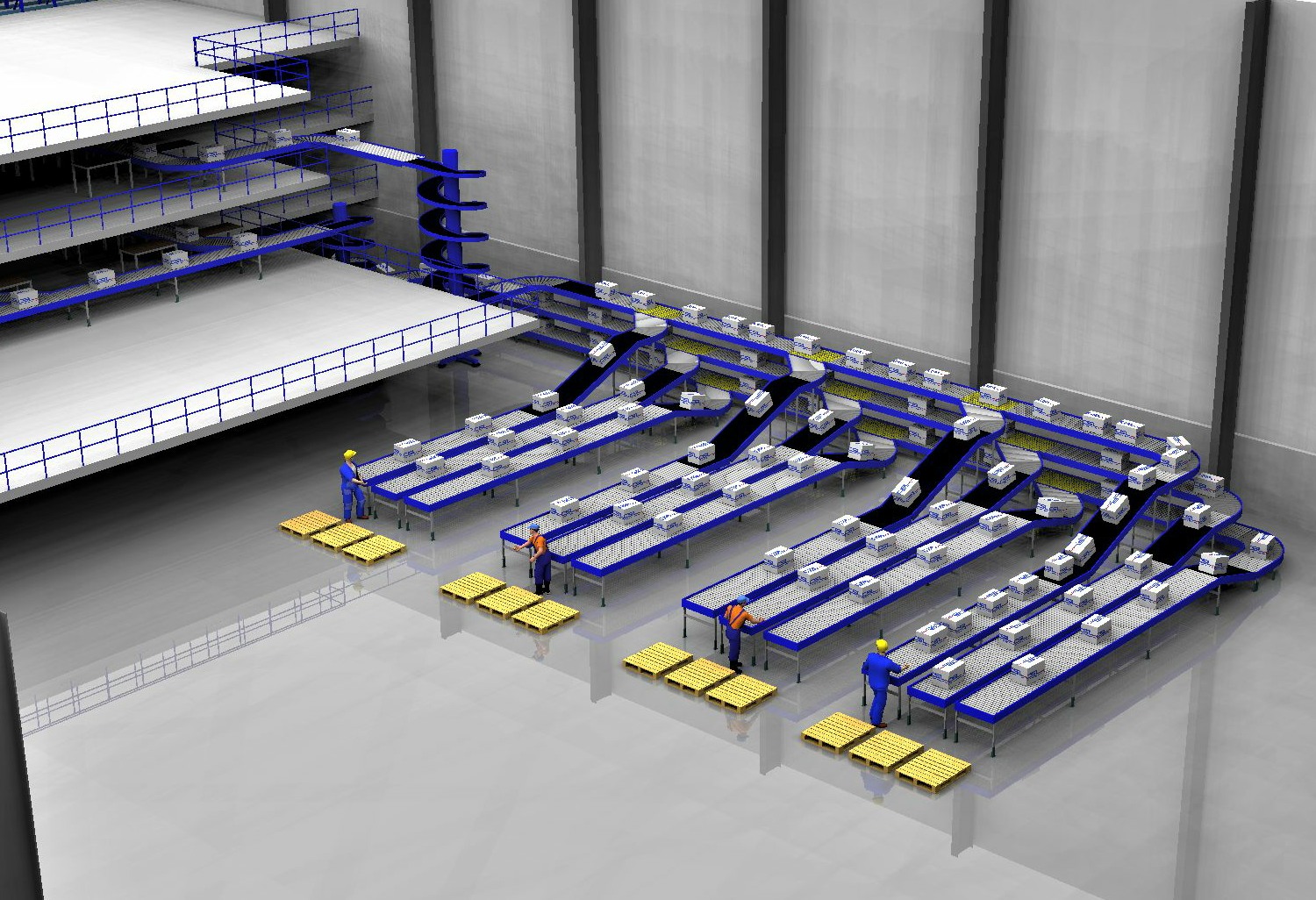
In 2015, continued growth led the business to consolidate several smaller sites in Portsmouth into a single 320,000 sq ft fulfilment centre in the West Midlands. CSL won the contract to design and install the conveyor solution after a rigorous tender process, in part by using 3D CAD software to present the system as a lifelike operational model inside the new building before a single frame was installed.
The brief: three pick floors, one dispatch operation
The core requirement was deceptively simple to state.
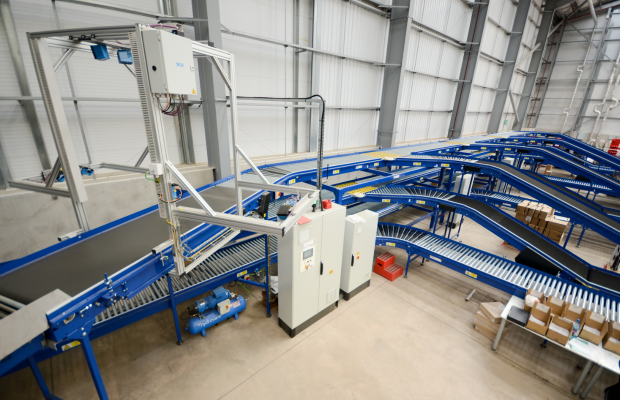
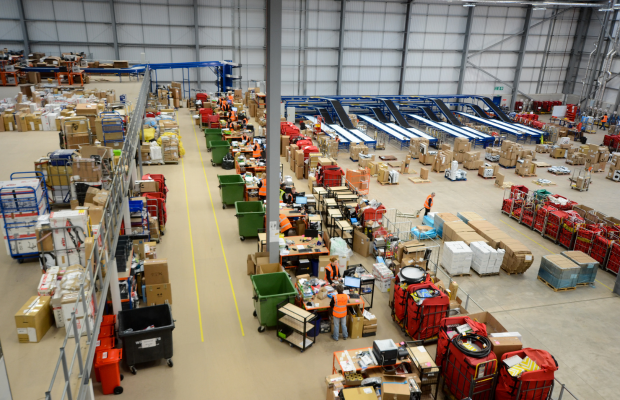
Combine packed consignments from three pick and pack areas spread over three floors, then sort them down twelve lanes into four dispatch zones for different carriers and services.
The system had to handle up to 90 boxes per minute, and the products were anything but uniform. Orders ranged from small clothing items and components up to large boxes of bicycle wheels.
That variety is the part procurement teams often underestimate. A line built for a narrow band of carton sizes behaves very differently once it has to carry poly bags, jiffy bags and oversized cartons on the same belts. Handling mixed products reliably at speed is where design detail earns its keep, and it shaped almost every decision on the Wiggle project.
Designing a pack and sortation conveyor system for product variety
CSL engineered a conveyor specially at over 900mm wide to accommodate the full spread of shapes and sizes. The design was developed in detail after gathering comments and suggestions from both management and operators at Wiggle, which matters more than it sounds. Operators know where product snags, where queues form, and where a theoretical layout meets an awkward reality.
To move packed orders without one consignment damaging another, the system makes wide use of zero line pressure (ZLP) accumulation roller conveyor. ZLP conveyor lets boxes queue without touching, so heavy cartons do not crush lighter poly bags and jams do not propagate back up the line.
You can read more about how this technology behaves on our roller conveyors page. Once an order is picked, packing operatives check it, pack it into the appropriate outer, apply the carrier label, and place it onto a ZLP section that begins its transit toward the ground floor sortation area.
Moving product between floors with spiral lowerators
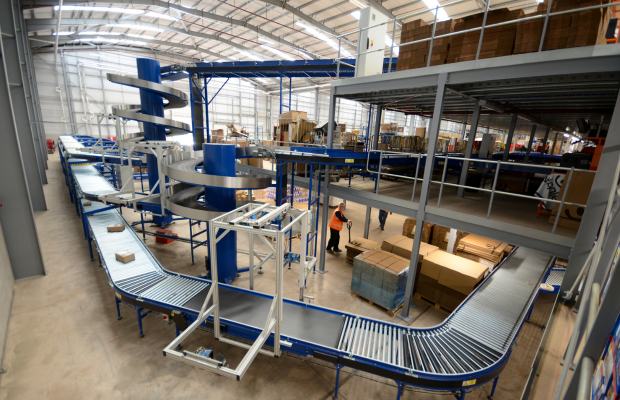
The mezzanine’s two upper floors, together with the ground floor, form three independent pick, pack and sortation zones. That independence was a deliberate design choice, made so that stopping one area for maintenance or repair does not halt the entire operation, a common weakness of single combined systems.
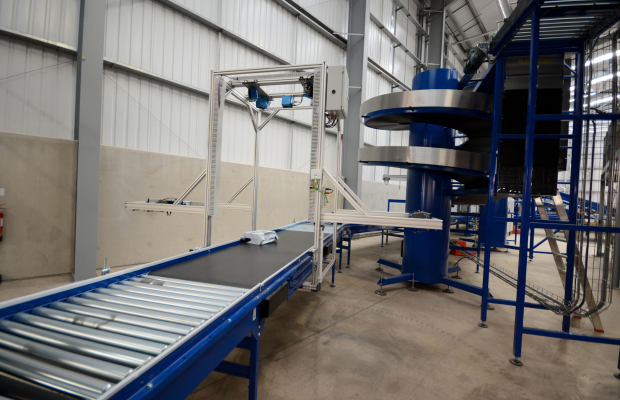
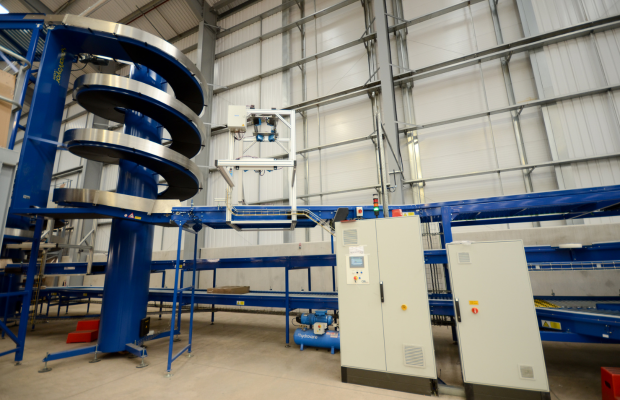
To bring packed boxes down safely and continuously from the upper floors, CSL installed two powered Ambaflex spiral lowerators. Spirals are a compact, reliable way to change levels in a busy building without the stop-start cycle of a goods lift, and CSL has supplied close to 100 of these units to customers across the UK.
Multi-floor movement of this kind is a specialism in its own right, covered on our multi-floor product handling and spirals pages.
Scanning and high-speed sortation
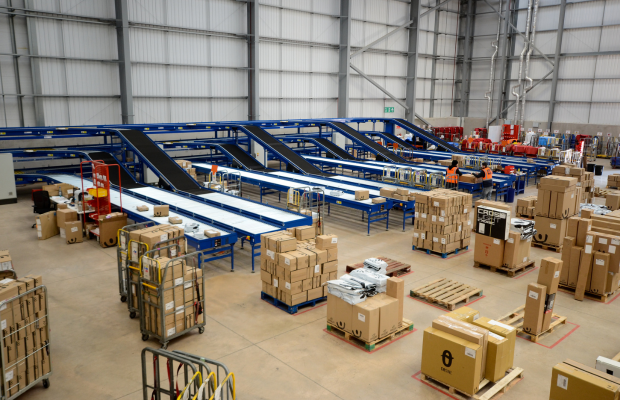
As boxes reach the lower level they pass through advanced scanning arrays on each line. Each carton is barcode scanned to determine which carrier dispatch lane it needs. When a package reaches the correct lane, high-speed switch sorters divert it off at 90 degrees. Depending on the source floor, the box then either declines down a grip top belt to an ergonomic picking height or transits on a horizontal roller conveyor to the discharge area.
There, a dispatch operative places it onto a pallet or into a wheeled cage ready for carrier collection.
This kind of automated product sortation is what turns a fast pick operation into a fast dispatch operation.
A turnkey project, visualised in 3D
CSL delivered the full turnkey conveyor project, including controls, installation and commissioning across the wide range of packages.
The 3D modelling used at tender stage carried through into delivery, giving the Wiggle team a clear picture of how the mezzanine and conveyors would work together before installation began. For a new facility, that visualisation removed a lot of the guesswork.
“As this was a new facility it was difficult to visualise the conveyor system prior to the mezzanine floor installation, but CSL provided a detailed 3D drawing which included both the mezzanine and the conveyors which brought clarity to this. The install process was smooth and the end results have allowed us to increase control, flexibility and volumes.”
Dan Corrigan, Head of Logistics and Operations Development, Wiggle
Design considerations for a multi-floor fulfilment operation
For operations and logistics leads specifying a similar system, several design decisions on the Wiggle project are worth carrying into any brief.
● Plan for product variety, not an average box. Belt widths, accumulation and sorter selection should be sized for the largest and most awkward items, not a notional average. Wiggle’s range ran from poly bags to boxes of bicycle wheels on the same line.
● Use accumulation to protect product. Zero line pressure conveyor lets consignments queue without contact, which prevents both damage and the jams that cascade back up a busy line.
● Keep zones independent. Separating the floors into independent pick, pack and sortation areas means a stoppage in one does not halt dispatch across the whole building.
● Design vertical movement in early. Spiral lowerators handle continuous multi-floor movement far better than a goods lift, and retro-fitting them later is disruptive and costly.
● Visualise before you build. A 3D model of the mezzanine and conveyors together lets the operations team spot problems while they are still cheap to fix on screen.
What the Wiggle project shows about a pack and sortation conveyor system
The lesson for any operations or logistics lead planning a similar move is that throughput figures are only half the brief. The other half is product variety, floor layout, and the need to keep dispatching while parts of the system are serviced. A pack and sortation conveyor system designed around those realities, rather than a single headline speed, is the one that still performs three years after go-live.
CSL works on projects like this across the ecommerce sector, from initial concept and 3D design through to installation and ongoing support.
If your operation is consolidating sites, moving building, or simply struggling to keep pace with order growth, contact our team to discuss what a tailored solution could look like.
Discuss your Project Requirements
Thank you for your interest in CSL Automation. As one of the UK’s leading conveyor and automation integrators, we can help maintain your automation system.
Start your automation journey today.
