
One Conveyor, Two Jobs: Conveyor System Integration for CEF
The most efficient warehouse systems often do more than one thing with the same infrastructure. That was the design principle behind CSL’s project for City Electrical Factors (CEF), where a single conveyor system handles both inbound replenishment and order picking, all controlled live through conveyor system integration with the client’s warehouse management system. It is a strong example of physical automation and software working as one.
CEF, formed in 1951, describes itself as the UK’s leading electrical wholesale network, with more distribution outlets than its nearest competitor. To support projected growth, the business commissioned a new 100,000 sq ft distribution centre which, with a two-level mezzanine, gave a total floor space of 160,000 sq ft. The requirement was to enhance the whole process from order placement to dispatch, increase throughput, and combine order picking, packing and dispatch with an inbound replenishment function that could interface with CEF’s in-house IT system.
The design challenge: shared infrastructure, two workflows
CEF turned to CSL as preferred partner after a tender process in which CSL carried out a proactive assessment of the project and demonstrated an understanding of its values. Using 2D and 3D modelling, the CSL design team developed a layout that stayed space efficient while keeping two distinct workflows running on shared infrastructure.
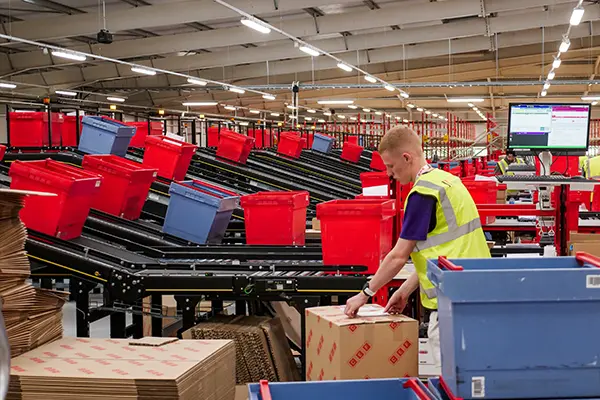
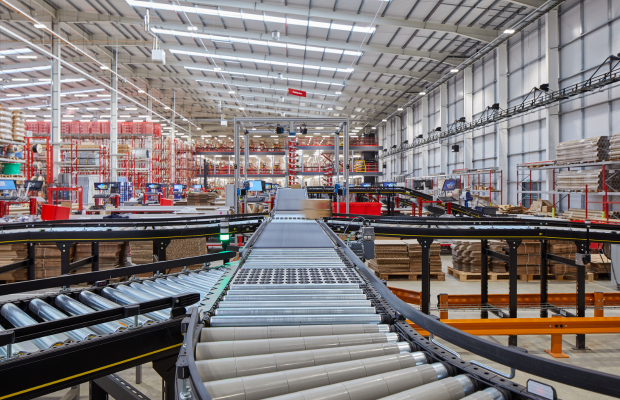
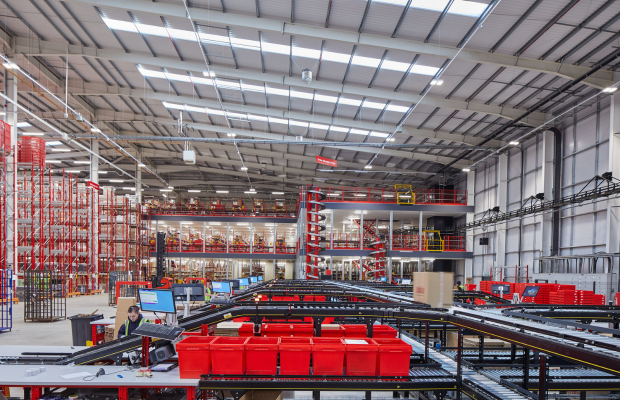
The system uses Interroll 24v motorised roller conveyor, which provides non-contact accumulation and zonal control across the whole system, with all peripheral devices also 24v controlled. The scope was defined by tote colour and product state: inbound replenishment stock travelled in grey totes, order picking in red totes that matched CEF’s corporate colours, and dispatched items as cartons, with every tote carrying a dedicated barcode.
Because replenishment and picking totes shared the same conveyor, an operator could instantly recognise whether an offloaded tote was a pick requirement or replenishment stock. The roller conveyors behind this dual function are the workhorse of the system.
Live control through conveyor system integration
The real intelligence sits in the control layer. CSL implemented a web based WCS and SCADA system that interfaces with CEF’s WMS, so conveyor routing can be controlled and amended in live time.
The WCS holds all historical data and provides over-arching control of the entire solution, and the client can dial into it from a PC or tablet anywhere with an internet connection. Routing of the totes is dictated by the WMS while offloading is controlled by the WCS, with a SICK barcode reader at each transfer point providing a confirmation read. This kind of integration and control software is what allows a physical conveyor to behave as an extension of the warehouse software.

How replenishment and picking flow through the building
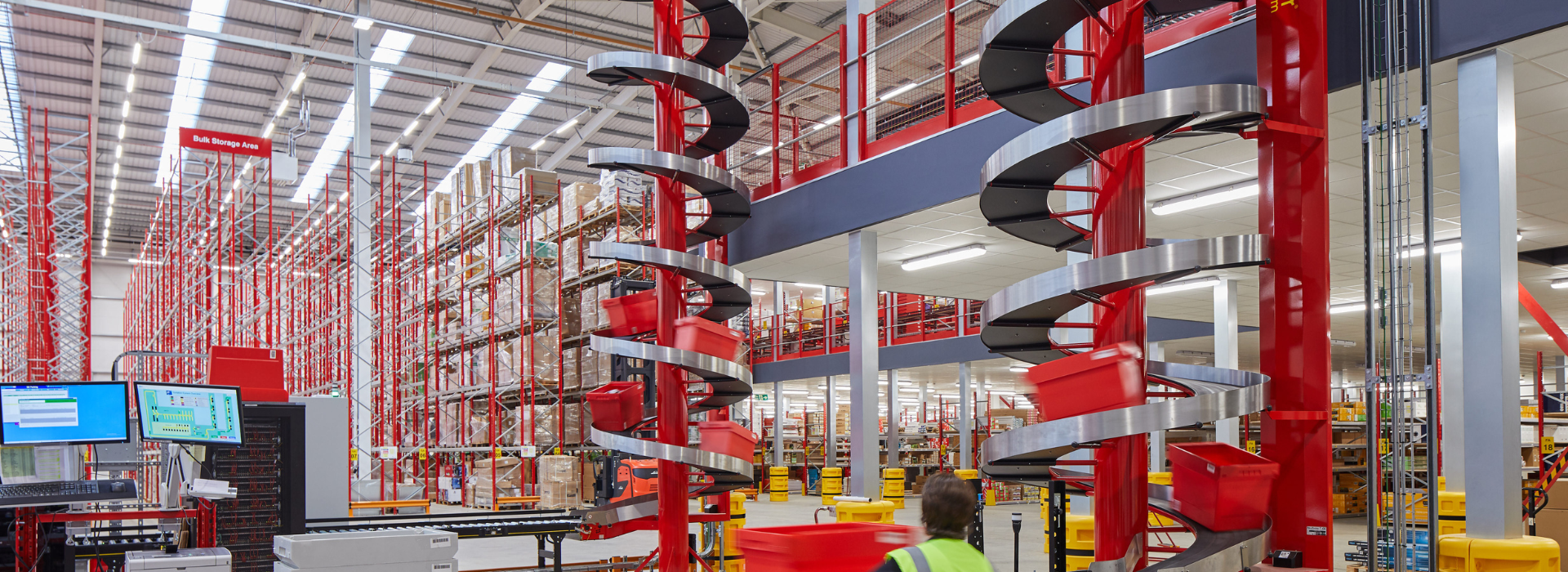
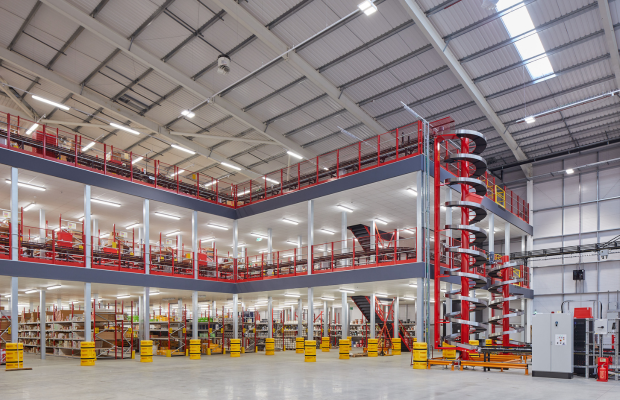
The first challenge was linking inbound replenishment stock, which arrived at the opposite end of the building, to the mezzanine storage and picking area. Booked-in stock was scanned into a tote and raised immediately to high level via an AmbaFlex spiral, then conveyed at high level on specially designed hangers that used the building columns at 7m centres, so no supports occupied ground floor space. New orders were assigned to a tote, inducted at ground level, and lifted by spiral onto the first floor mezzanine, where the replenishment flow merged into one common roller conveyor.
Replenishment and picking take place over two mezzanine floors. Each floor has four offload transfers, each with a bi-directional transfer and spur conveyor, giving eight locations per floor. If an order needs consolidating from another location, or cannot access its required offload, it continues to visit the other locations it needs and is then raised to the second floor via another spiral, where the process repeats. The multi-level movement here relies on CSL’s stock replenishment and order picking solutions working as one.
Consolidation, packing and dispatch
Completed order picks and empty replenishment totes are lowered to the ground floor via a fourth AmbaFlex spiral and delivered to one of 40 pack benches on a two-tier conveyor system. Any item that could not reach its destination is recirculated under WCS control rather than being pulled off manually. The dual-sided pack benches share a common incline belt onto which packed items are loaded, and all dispatch cartons merge onto the top tier of the two-tier conveyor. At the end of the line, a four-way SICK scanning array reads the front, both sides and top of each carton for a courier label, and two Interroll high performance diverters sort cartons to one of four dispatch lanes.
“I have found working with CSL the ideal partnership. They understood the brief and worked closely with CEF to ensure the design met all of the criteria. The support from start to finish was excellent. The project ran smoothly from start to finish. The conveyor system has made our new warehouse very efficient and allowed us to increase the throughput.”
Craig Marks, Divisional Manager, CEF Online
What a dual-function conveyor actually saves
Running replenishment and picking on the same infrastructure is not a neat trick for its own sake. It changes the economics of the system. One set of conveyor, spirals and controls does the work that two separate flows would otherwise need, which reduces both the capital cost and the floor space the system occupies. The colour-coded totes matter here too: because an operator can tell a grey replenishment tote from a red picking tote at a glance, the dual flow adds no cognitive burden on the floor.
The automatic recirculation is the other quiet saving. When an order cannot reach its required offload, the WCS keeps it moving and re-presents it rather than dropping it out for a person to
handle. On a manual or loosely controlled system, those exceptions are exactly what pull operators off productive work. Handling them in software keeps the floor focused on picking and packing.
For a buyer weighing up integration, the practical questions are worth setting out early:
● Will the conveyor take its routing from the WMS, or duplicate it? Live routing from the existing WMS avoids a second source of truth.
● How are exceptions handled? Automatic recirculation under WCS control keeps blocked orders moving without manual intervention.
● What visibility does the control layer give? A web-based WCS that holds historical data and can be reached from a PC or tablet turns the system into a source of operational insight, not just movement.
● Can peripheral devices share the same control standard? Keeping scanners, diverters and gates on the same 24v control simplifies both commissioning and support.
Why integration is the difference
The CEF project shows that the value of a modern conveyor system is not only in the steel and rollers, but in how tightly it integrates with the software that runs the warehouse.
A dual-function line that serves both replenishment and picking, routed live by the WMS and recovered automatically when an offload is blocked, does more with less hardware and less manual intervention. For operations handling large product ranges, that integration is where the throughput gains come from.
CSL delivers automation across the warehouse and distribution sector, with in-house design, controls and integration. To discuss integrating a conveyor system with your own WMS, contact our team.
Discuss your Project Requirements
Thank you for your interest in CSL Automation. As one of the UK’s leading conveyor and automation integrators, we can help maintain your automation system.
Start your automation journey today.
