
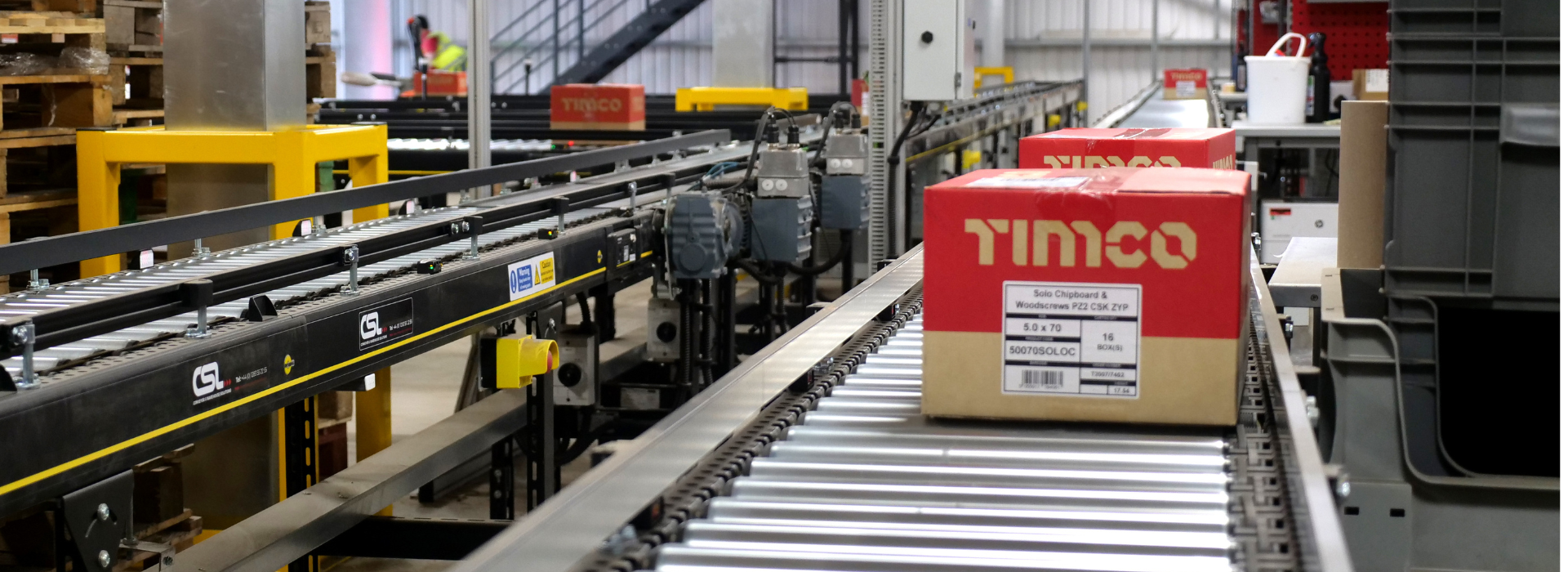
Distribution Centre Automation in Action: The TIMCO Project
Rapid product range growth is a good problem to have and a hard one to fulfil. TIMCO, a supplier that has launched over a thousand new products a year, reached the point where its Nantwich distribution centre needed more storage space and a more efficient, automated materials handling operation to keep up. This is a common trigger for distribution centre automation, and TIMCO’s project shows how a phased approach can deliver results without a disruptive single switchover.
TIMCO invited several companies to tender for the expansion. Its Head of Marketing, Charlie Du Pre, described a very competitive pitch process for a project that was critically important to the business. CSL’s advantage, in his words, was a willingness not only to listen to requirements but to understand the business model and how it might evolve.
That distinction, between quoting against a spec and designing around a business, runs through the whole project.
The starting point: a manual operation under pressure
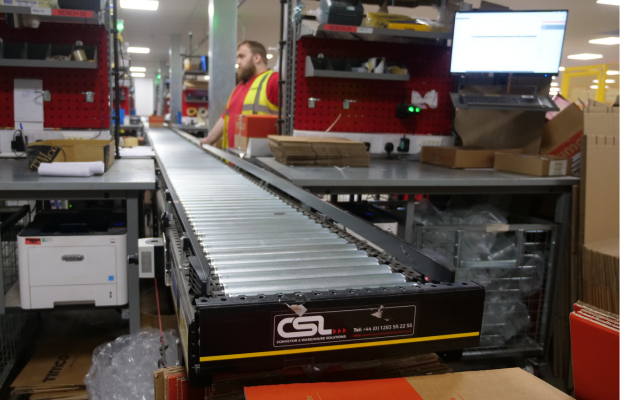
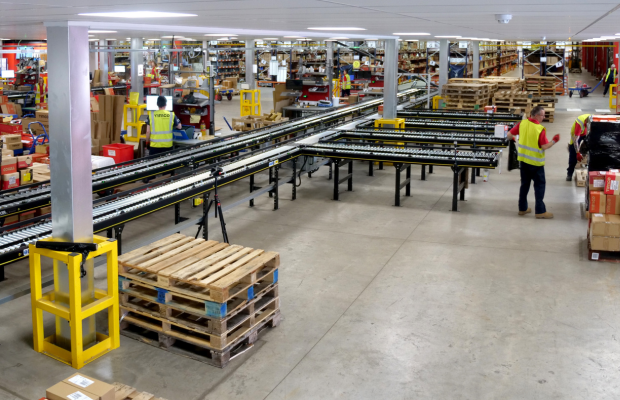
Before CSL’s involvement, the TIMCO DC was essentially a manual pick and pack operation. Manual handling scales badly.
As order volumes rise, more of the working day goes into walking product around the building, and error rates and dispatch times climb with it. The brief was to introduce automation that sped up the movement of stock and orders through the DC while making room for further growth.
Signs a distribution centre has outgrown manual pick and pack
TIMCO’s trigger for automation, launching over a thousand new products a year, is a familiar one. The symptoms of a manual operation reaching its ceiling tend to appear together rather than one at a time:
● Dispatch cut-off times slipping as volumes rise, even after adding more staff to the floor.
● A growing share of the working day spent walking product between packing benches and carrier stations.
● Error rates and mis-ships climbing during busy periods, when manual sortation is under the most pressure.
● Storage and picking spilling into space that was never designed for it, often a mezzanine added in a hurry.
When several of these appear at once, the constraint is rarely a single bottleneck that can be staffed around. It is the manual process itself, and that is the point at which conveyor automation starts to repay the investment quickly.
Phase one: a zero line pressure roller conveyor system
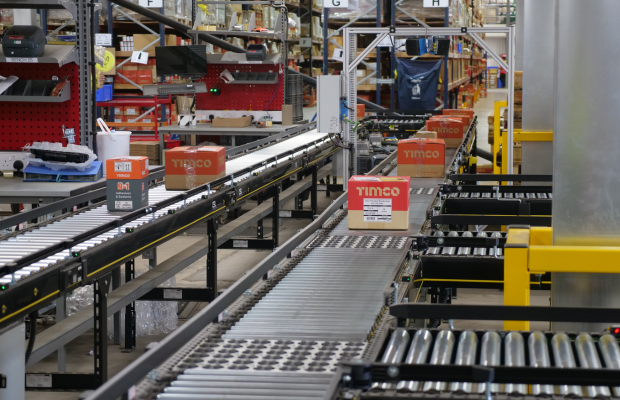
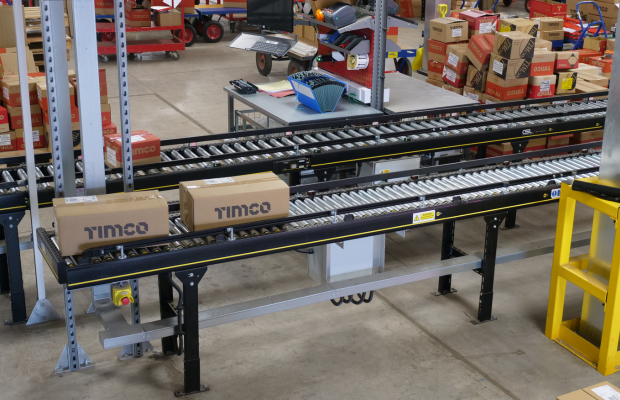
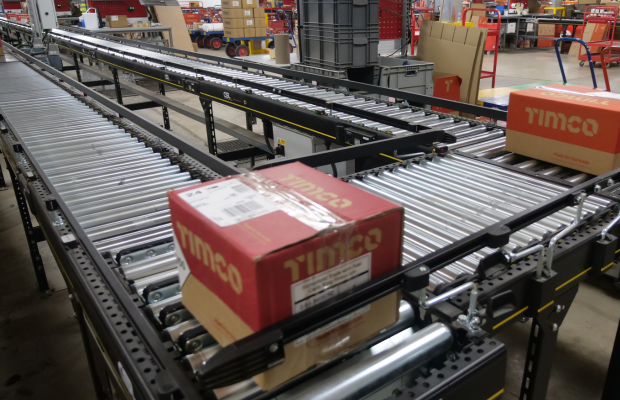
In the first phase, CSL designed and installed a powered roller conveyor system serving both the mezzanine and ground floors. The system used 24v zero line pressure conveyor, which moves stock and orders through the building while allowing cartons to accumulate without contact.
That non-contact queuing protects product and prevents the jams that manual handling and simpler conveyors tend to create. The behaviour and benefits of this technology are covered on our roller conveyors page.
The choice of zero line pressure conveyor is worth dwelling on, because it is easy to under-value at specification stage. On a simple gravity or continuously driven line, cartons run into each other and queue under pressure.
That pressure damages lighter packages, makes it hard to release a single carton cleanly onto a sorter, and turns one stopped box into a line-wide jam. Zone-controlled ZLP conveyor holds each carton in its own driven zone and releases it only when the zone ahead is clear, which is what lets a mixed-product operation accumulate safely and meter cleanly onto the sortation line.
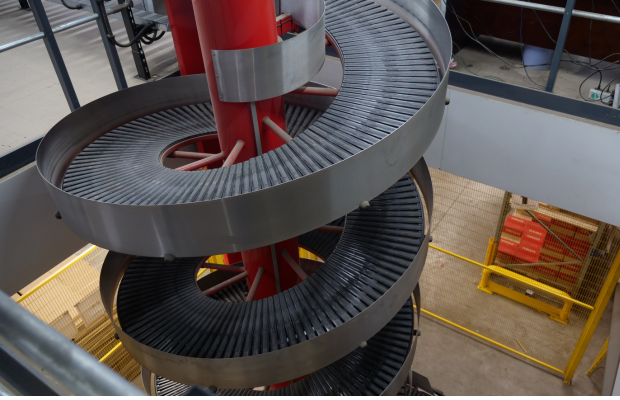
To move product between levels, CSL sourced and fitted a spiral conveyor that carries totes up to, and down from, the mezzanine floor. Spirals give continuous vertical movement in a small footprint, which is valuable when floor space is exactly the thing in short supply. There is more detail on our spirals page.
Sortation to the right carrier, every time
The conveyor’s primary job was to take packed cartons from the multiple packing benches and convey them to the outbound carrier stations. Along the way, each carton passes through a barcode scanner array that determines which carrier lane it belongs to. CSL achieved the sortation using swivel wheel sorters that divert boxes off at 90 degrees to the correct dispatch line. Reliable product sortation is what lets a DC run multiple carriers and services from one packing operation without manual sorting at the end of the line.
Swivel wheel sorters suit this kind of carton handling well. The wheels turn to divert a box off the line at 90 degrees without stopping the flow, so the system can sort to several carrier lanes at speed while keeping a single, simple main line. Matching the sorter type to the product and the required rate is one of the design decisions that most affects whether a system holds up under peak load.
Phase two: designed to be extended
Because the system was designed with growth in mind, extending it was straightforward. Following phase one, TIMCO asked CSL to upgrade the system to accommodate more packing benches, and according to Charlie Du Pre, CSL again delivered on time and in budget. Designing for extension from the outset is one of the quieter advantages of working with an integrator that takes time to understand where a business is heading, not just where it is today. Our phased approach to projects is built around exactly this.
Phasing also makes the investment easier to justify internally, which matters for a time-poor operations lead who has to agree costs before proceeding. A first phase with a clear, measurable result, in TIMCO’s case over 5,000 lines a day leaving the ground floor, builds the internal confidence and the business case for the next stage. It spreads the cost over time, and it lets the design of later phases learn from how the first performs in practice.
“The automation solution CSL provided has made our DC operation way more efficient; we are seeing an increase in those lines stored on the first floor mezzanine with upwards of 3,000 lines a day being despatched. And on the ground floor we’re achieving over 5,000 lines a day going out of the building.”
Charlie Du Pre, Head of Marketing, TIMCO
“The upgrade after phase one is the proof of the approach. Because the original system was designed to be extended, adding packing benches was an enhancement rather than a rebuild, delivered, in the client’s words, on time and in budget. That is the practical payoff of designing for growth from day one.
What TIMCO shows about distribution centre automation
TIMCO’s project is a clear case for treating automation as a staged programme rather than a one-off purchase. A first phase that removes the worst manual bottlenecks can pay back quickly, while a design that anticipates further benches, lines or throughput makes the next phase cheaper and less disruptive. For businesses launching new product lines at pace, that flexibility is often worth as much as the raw efficiency gain.
CSL designs and installs automation across the warehouse and distribution sector, from single-phase upgrades to full turnkey systems. If your DC is straining against a manual process, talk to our team about a solution that can grow with you.
Discuss your Project Requirements
Thank you for your interest in CSL Automation. As one of the UK’s leading conveyor and automation integrators, we can help maintain your automation system.
Start your automation journey today.
