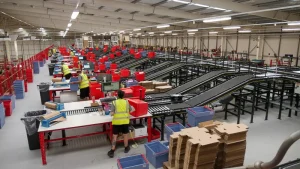

Pick-To-Light / Put-To-Light
Increase pick accuracy and boost pick rates
What is Pick-To-Light?
What is pick to light:
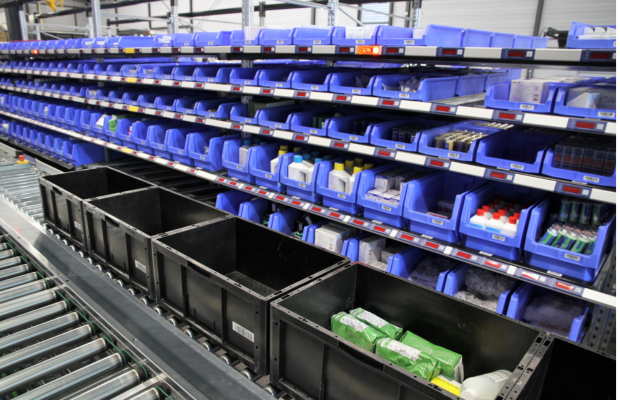
Pick to Light technology uses illuminated displays mounted on shelving, flow racking, or pick modules to guide operators to the correct SKU location. Operators confirm picks via buttons, sensors, or touch pads, with real‑time data sent back to your WMS/WCS for immediate inventory accuracy
Perfect for:
- High‑SKU piece picking
- Fast‑moving e‑commerce operations
- Kitting and assembly lines
- Multi‑level pick modules integrated with conveyors

Key Operational Benefits
Operators confirm the pick / put by pressing a button and can override the pick quantity requested if there are shortages.
- Accuracy up to 99.5% – Eliminates mis‑picks and improves customer satisfaction.
- 2–4× Faster Picking – Light‑directed guidance removes searching time and reduces walking.
- Rapid Training Time – Ideal for seasonal workforces or sites with high staff turnover.
- Real‑Time System Visibility – Live productivity, stock levels, and order completion data.
How Pick to Light Works
- Operator scans order / tote arrives via conveyor.
- Lights illuminate at the correct pick locations.
- Display shows quantity required.
- Operator confirms pick via button, infrared, or capacitive touch.
- Real‑time updates flow into the WMS/WCS.
Optional: Integrate barcode scanning or RFID for additional validation.


Key Operational Benefits
Pick-to-light systems streamline order fulfillment by guiding operators with illuminated cues, significantly improving speed, accuracy, and consistency in picking operations.
Pain points resolved by pick-to-light systems:
High picking error rates caused by manual searching, paper lists, or screen-based instructions
Slow order fulfillment due to inefficient navigation and decision-making during picks
Labor dependency and training challenges, especially for new or temporary workers
Inconsistent productivity driven by worker fatigue or varying experience levels
Order verification bottlenecks that require secondary checks or rework
Operational complexity in high-SKU or high-volume environments, where traditional methods struggle to scale















What is Put-To-Light?
Put to Light technology uses illuminated indicators on put walls, shelving, or sortation frames to direct operators to the correct order location. Lights show where each item should be placed, enabling fast, high‑volume multi‑order sortation. Confirmations are recorded through sensors or buttons and fed directly into your WMS/WCS.
Perfect for:
- eCommerce fulfilment and returns
- Multi‑order picking in 3PL facilities
- Manufacturing assembly and kitting
- High‑SKU retail distribution
- Pharmaceutical and healthcare picking
Key Operational Benefits
- High‑Speed Order Sortation – Ideal for batch picking workflows where thousands of orders are processed simultaneously.
- Exceptional Accuracy (99%+) – Reduce order errors and streamline outbound processes.
- Ultra‑Fast Training Time – Simple visual guidance is perfect for peak‑season hiring or high turnover environments.
- Improved Throughput and Workflow Flow – Enhances downstream conveyor and packing station productivity.
How Put to Light Works
- Items are batch picked and inducted into the put wall (manually or via conveyor).
- Lights illuminate at the location corresponding to the correct customer order.
- Quantity is displayed or confirmed via button/sensor.
- The WMS/WCS updates order status instantly.
- Completed orders are released to packing stations.
The same technology can be used in a reverse function for ‘Put Away’ replenishment functions and order consolidation functions via a Put Wall.
eCommerce fulfilment centres: High-volume order picking for direct-to-consumer shipments.
Warehouses: Efficient inventory management and order picking for various supply chain processes.
Factories: Assisting in the assembly process by guiding workers to the correct components.
Distribution centres: Streamlining the sorting and picking of items for shipping to retail locations.
WMS/WCS Connectivity
- API or middleware integration
- Real‑time pick confirmation
- Stock decrement and order status updates
- Error alerting and operator prompts
Conveyor System Integration
- Tote arrival triggers pick lights
- Batch or wave picking
- Linked to sorters, put walls, or goods‑to‑person systems
Data & Analytics
- Faster put-away – Streamlines the workflow, reducing time spent on each task.
- Improved accuracy – Visual guidance and instant confirmation reduce the risk of misplacements.
- Enhanced productivity – Operators can complete more tasks in less time due to the system’s intuitive design.
- Reduced training time – Simple operation makes learning easier for new employees.
- Scalability– Easily adapts to growing operations or changes in warehouse layouts.
- Operates in temperatures between -25°C to +50°C
Discuss your automation Project
Thank you for your interest in CSL Automation. As one of the UK’s leading conveyor and automation integrators, we can help design and install a system to help you take your business to the next level.
Start your automation journey today.
Frequently Asked Questions
Can Pick to Light be combined with conveyors for a complete solution?
What is PUT to Light?
How does pick to light integrate with WMS?
Most Pick-to-Light systems are highly scalable — they can support hundreds to tens of thousands of SKUs, depending on hardware configuration and the backend system (WMS/ERP) integration.
• Small to mid-size deployments might handle 500–2,000 SKUs easily.
• Large facilities with dense shelving and zone segmentation can support 10,000+ SKUs by adding more light modules and zones.
Scalability is essentially limited by physical light module count and the host system’s capacity.
How scalable is Pick To Light?
Pick to Light (PTL) systems are highly scalable and can grow alongside a business’s operational needs. Their scalability depends on several key factors:
- Modular Design – PTL systems are modular, meaning you can start with a small setup and expand by adding more light-enabled locations as demand increases.
- Integration with WMS/WCS – A well-integrated PTL system works seamlessly with Warehouse Management Systems (WMS) and Warehouse Control Systems (WCS), allowing easy adjustments to picking zones and workflows.
- Multi-Zone expansion – PTL can be deployed across different warehouse zones, and additional zones can be integrated over time without disrupting existing operations.
- Handling seasonal peaks – PTL is ideal for businesses with fluctuating demand, such as eCommerce and 3PL, since it allows temporary expansions or reconfigurations during peak periods.
- Technology upgrades – Many PTL solutions can be enhanced with IoT (Internet of Things) connectivity, RFID, and AI-driven analytics, ensuring they remain effective as warehouses adopt more automation.
How many SKUs can your system support?
Most Pick-to-Light systems are highly scalable — they can support hundreds to tens of thousands of SKUs, depending on hardware configuration and the backend system (WMS/ERP) integration.
• Small to mid-size deployments might handle 500–2,000 SKUs easily.
• Large facilities with dense shelving and zone segmentation can support 10,000+ SKUs by adding more light modules and zones.
Scalability is essentially limited by physical light module count and the host system’s capacity.
Can it be retrofitted to existing shelving?
Yes. Pick-to-Light is commonly retrofitted to existing racking, shelving, and workstations. The light modules and wiring can be mounted on almost any structure with minimal structural alteration. Typical retrofit configurations include:
• Standard shelving racks
• Workbenches
• Flow racks
• Mezzanine pick zones
Most systems are modular and designed for retrofit without replacing the shelving itself
What is the typical ROI?
ROI varies by operation size, order volume, and labor cost, but typical projected returns are:
• 6–18 months in many use cases
• In high-volume picking environments, medium ROI is often achieved within 9–12 months
Factors that drive ROI include labor savings, error reduction (rework cost avoidance), increased throughput, and improved accuracy—often exceeding 99% pick accuracy with light guidance.
How quickly can operators be trained?
Training is generally very fast because Pick-to-Light is intuitive:
• Most operators are productive within 1–2 hours of hands-on instruction
• Full proficiency is often reached within 1–2 shifts
The visual prompts reduce the need for extensive classroom training compared with paper or voice-based picking.
More Information
What is Pick to Light?
Installation time depends on scale but typical timelines are:
• Small deployment: 1–2 days
• Mid-size deployment: 3–7 days
• Large facilities: 1–3+ weeks
This includes mounting lights, wiring/power, integration with WMS/ERP, and testing. Preparation (e.g., rack labeling and zone planning) usually occurs prior to hardware deployment.
Typical applications of Pick to Light
Pick to Light systems are commonly used in:
- eCommerce fulfilment centres: High-volume order picking for direct-to-consumer shipments.
- Warehouses: Efficient management of inventory and order picking for various supply chain processes.
- Factories: Assisting in the assembly process by guiding workers to the correct components.
- Distribution centres: Streamlining the sorting and picking of items for shipping to retail locations.
Benefits of implementing Pick-to-Light
- Increased picking accuracy
Pick to Light significantly reduces picking errors by clearly indicating the precise location and quantity of items. This visual guidance minimises the chances of human error, ensuring that customers receive the correct products. Increased accuracy directly translates to fewer returns and higher customer satisfaction. Multiple pickers can operate within the same pick face with alternate coloured lamps
- Improved speed of picking
With Pick to Light, operators can quickly identify where items are located without reading lengthy picking lists or using handheld devices. The lights provide immediate visual cues, for the product location and quantities to be picked – illuminated, drastically reducing the time spent searching for items. This leads to faster order fulfilment and the ability to handle higher order volumes, particularly during peak periods.
- Ease of use for the operator
The simplicity of Pick to Light systems makes them highly user-friendly. Minimal training is required for operators to become proficient, which is particularly beneficial in environments with high staff turnover or seasonal employment. The intuitive nature of the system ensures that even new employees can quickly reach high levels of productivity.
- Enhanced customer satisfaction
By ensuring that orders are picked accurately and shipped quickly, Pick to Light contributes directly to improved customer satisfaction. Customers receive the correct items promptly, enhancing their overall shopping experience and increasing the likelihood of repeat business.
- Seamless integration with other technologies
Pick to Light systems can easily integrate with other warehouse technologies, such as Warehouse Management Systems (WMS), Enterprise Resource Planning (ERP) systems, and automated storage and retrieval systems (ASRS). This integration allows for real-time updates and coordination across various operational processes, further enhancing efficiency and accuracy.
- Flexibility and scalability
Pick to Light systems are highly flexible and can be customised to fit the specific needs of different operations. Whether you are running a small warehouse or a large fulfilment centre, these systems can be scaled up or down to meet changing demands. This adaptability ensures that the investment in Pick to Light remains valuable as your business grows.
- Reduced training time and costs
The visual and intuitive nature of pick-to-light systems means that new operators can be trained quickly and with less expense. This reduction in training time is particularly advantageous during peak seasons when temporary staff may be required.
Conclusion
In the competitive landscape of eCommerce, fulfilment centres, warehouses, and factories, the adoption of Pick to Light technology offers a substantial edge. From improving picking accuracy and speed to enhancing customer satisfaction and ease of integration with other systems, the benefits are clear and compelling. As businesses strive to optimize their operations and meet ever-increasing customer expectations, Pick to Light stands out as a robust and effective solution.
By implementing Pick to Light, operations managers and directors can ensure smoother, faster, and more accurate picking processes, ultimately leading to more satisfied customers and a more efficient operation. Investing in this technology not only boosts current performance but also positions your business for future growth and success.